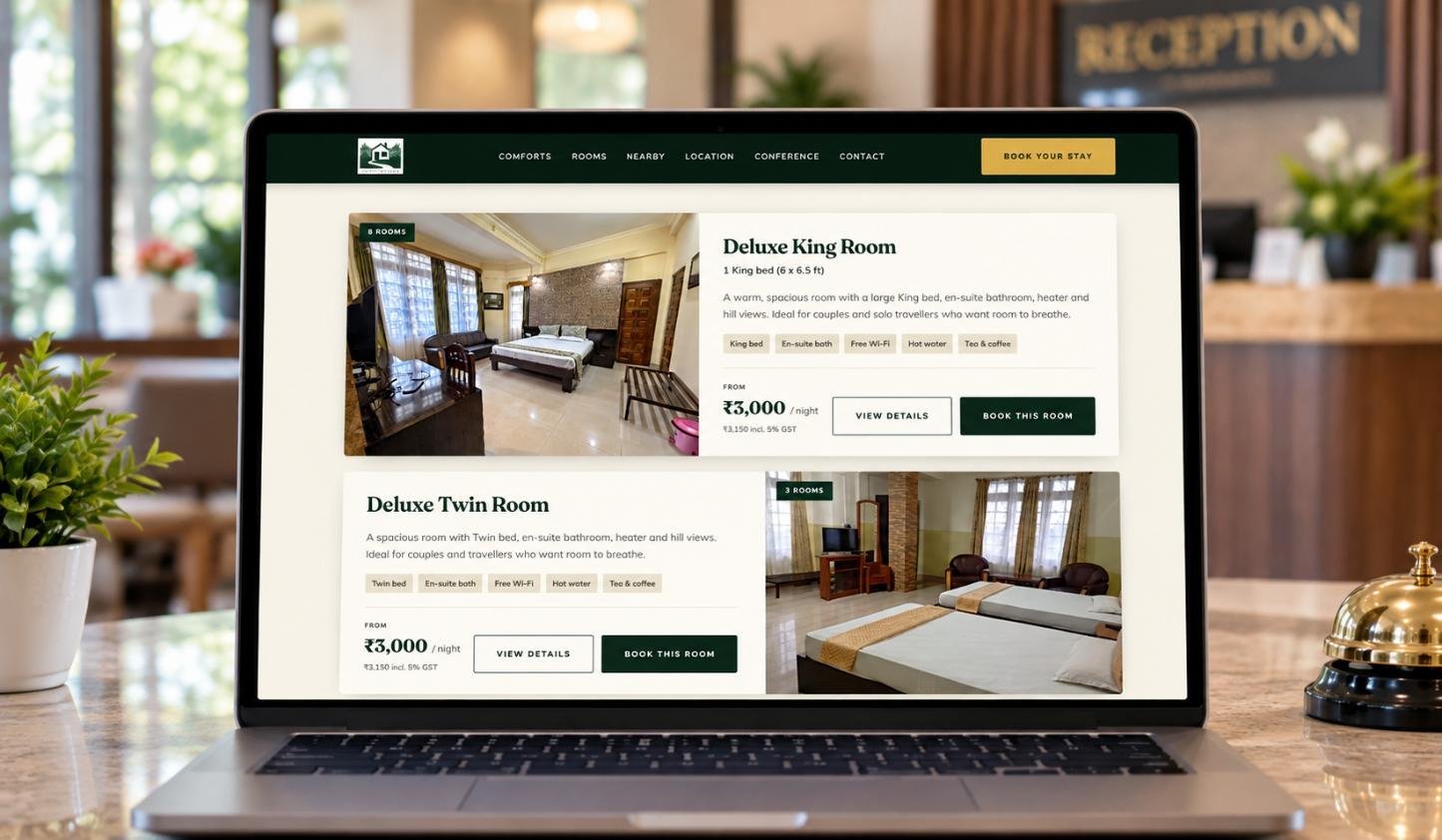
When Apsara Guest House came to us, the brief sounded simple: “We want direct bookings. No MakeMyTrip, no Agoda, no commission.” Simple to say. Surprisingly nuanced to build correctly. Here’s an honest account of what we built, why we made the decisions we did, and what any independent guest house or boutique hotel in India can take away from it.
Most hoteliers know OTAs take 15–25% per booking. That number stings, but it’s visible. What’s less visible is how that commission buys you something genuinely hard to replicate: a frictionless checkout. When a traveler books on Booking.com, their card is charged instantly, the booking is confirmed, and nobody has to talk to anyone. That smoothness costs you a quarter of your room revenue. So the obvious answer — “just build your own site and add Razorpay” — runs into a different wall immediately. Razorpay and Cashfree charge 2–3% per transaction on top of setup fees and mandatory KYC. For a 10-room guest house doing ₹500–800 per night, you’re still bleeding on every booking, just to a different middleman. And if you’re a small property without full merchant documentation, that KYC process is a weeks-long nightmare. We decided to solve for a guest house that genuinely wanted zero infrastructure cost and zero commission — not just lower commission.
India’s UPI ecosystem made the answer obvious once we stopped thinking in payment gateway terms. Any bank account with a UPI ID can receive money instantly, directly, with zero cut taken. Every Indian with a smartphone already knows how to scan a QR code and pay. So we built around that instead of against it. Here’s the exact booking flow we engineered for Apsara Guest House. The guest browses rooms, selects their dates, and clicks Book. The system calculates the total, generates a dynamic UPI QR code pointing to the property’s UPI ID, and displays it alongside the payment amount. A one-click WhatsApp button sits right next to the QR, pre-filled with the booking reference and a prompt to attach the payment screenshot. The guest pays via their UPI app, WhatsApps the screenshot, and the property owner verifies the credit in their own bank app before confirming the reservation.
The confirmation is manual, and that’s intentional. The property owner stays in control — they verify what actually landed in their account, not what a screenshot claims. This is what prevents fake payment fraud without needing a fraud-detection API costing thousands a month. But building this raised a problem nobody talks about openly: the double-booking window. The gap between a guest paying and the owner confirming creates a brief vulnerability. Our solution was to move the selected dates into a pending hold state in the availability calendar the moment a booking request is submitted. They don’t appear as confirmed to other visitors, but they’re also not freely bookable. If the payment isn’t verified within a set window, the hold releases automatically. It’s a small mechanism, but without it the system breaks down under any real booking volume.
There was a second problem that’s harder to solve with code alone. An OTA listing carries Booking.com’s credibility. A standalone guest house website doesn’t. We addressed this with two things working together: the WhatsApp flow itself, because direct human contact builds trust faster than any design element ever will, and structured local SEO so the property appears for searches like “guest house near [landmark]” before a traveler even lands on an OTA. We also made an early decision to design the entire QR-to-WhatsApp checkout for mobile first — not as an afterthought, but as the primary surface — because that’s how guests actually book, on their phone, often while already traveling.
The financial shift this creates for the property owner is real, but the operational shift matters just as much. When a guest books through MakeMyTrip, you get a masked email, a restricted chat thread, and a guest who arrives having dealt with a corporate portal, not you. When they book direct, they’ve already WhatsApp’d you. You know their name, their ETA, their questions. You’ve shared a location pin and check-in instructions. That relationship starts well before arrival, and it shows in reviews and repeat bookings. Cash flow changes too. OTA settlements come weekly or monthly with deductions. UPI payments arrive in your account the moment the guest pays — for a small property managing cash carefully, that difference is genuinely meaningful.
This was built on our custom PHP-based CMS, the same engine we use across our hospitality and healthcare projects. The booking module handles room availability by date range, dynamic QR generation keyed to the booking amount and property UPI ID, WhatsApp redirect with pre-filled message strings, and an admin panel for confirming or rejecting pending bookings and managing availability blocks. There is no payment gateway SDK, no webhook dependency, and no third-party subscription. The system works as long as UPI works — which, in India, is reliably.
This approach is the right fit for guest houses, homestays, and boutique hotels that want direct guest relationships, operate under roughly 50 rooms, and either cannot or prefer not to go through merchant KYC with a payment gateway. It is not the right fit if you need automated international card payments or if you are running a large inventory where manual confirmation at scale creates a bottleneck. Knowing those limits is part of building something that actually works for the people using it, rather than something that looks complete on paper but fails in daily operation.
Every tool we reached for to solve this brief — UPI, WhatsApp, a lean PHP booking engine — already existed and was already free. What was missing was the decision to use them deliberately instead of defaulting to the OTA or gateway path because everyone else does. That’s the pattern we keep finding in hospitality software projects: the constraint isn’t technology, it’s the assumption that professional means expensive third-party infrastructure. If you run a guest house or hotel and want to explore what a direct booking setup would look like for your property, reach out to the team at Cognition Venture at +91 80167 86669 or connect on WhatsApp to start the conversation.