
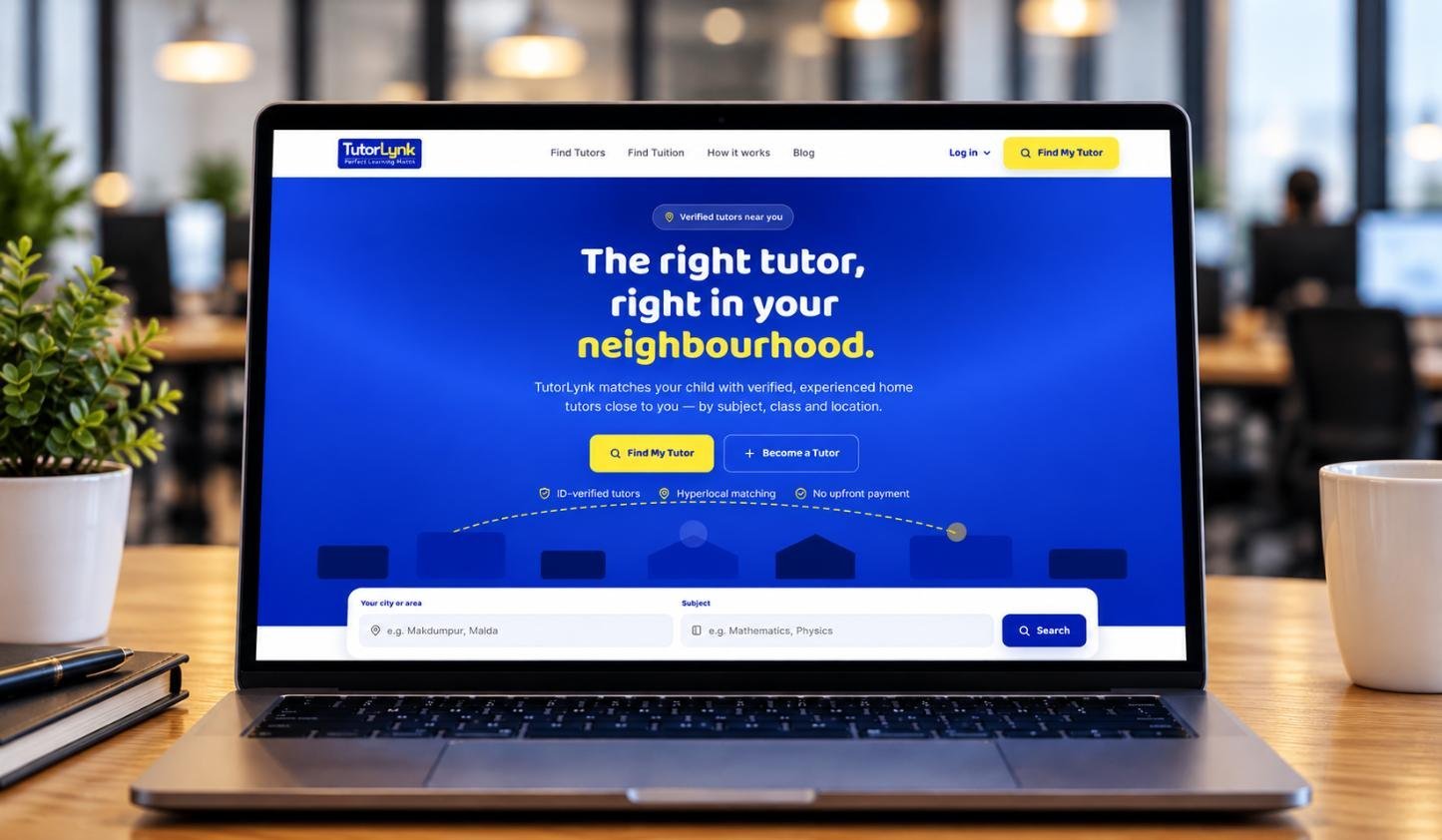
The global tutoring market is valued at over $200 billion, with its online component growing at roughly 15% annually. Yet in hundreds of Tier 2 cities across India, finding a verified tutor still means asking neighbours or scrolling through WhatsApp groups. That gap is exactly why tutor marketplace platforms are being built right now, and why entrepreneurs are searching for developers who understand this space. This guide walks you through how to build a tutor marketplace platform, from niche selection to feature planning to development costs. It also shows how Cognition Venture built TutorLynk, a working tutor discovery platform for Malda, as a real-world example of what a focused marketplace can look like.
A tutor marketplace is a two-sided platform that connects students or parents with tutors. The core transaction flow starts when students search for tutors based on subject, price, availability, or location, then review tutor profiles before booking a session. Unlike a simple directory listing, a full marketplace handles the entire journey: discovery, verification, booking, payment, and follow-up. The platform earns revenue through commissions on lessons, subscription fees for tutors, or listing charges. TutorLynk, built by Cognition Venture, is a location-focused marketplace that matches families with ID-verified tutors based on subject, class, and locality. It operates in Malda, West Bengal, and was designed specifically for the discovery and matching phase of the tutoring journey.
Three shifts make this the right time to build a tutor marketplace. First, Tier 2 and Tier 3 demand is underserved. National platforms like UrbanPro and Wyzant focus on metros, while local cities have huge demand but almost no verified digital infrastructure. Second, parents are searching online. Even in smaller cities, parents now Google "home tutor near me" before asking neighbours. Third, low-code options have lowered costs. A full-featured tutor marketplace built with FlutterFlow costs between $20,000 and $55,000, compared to $80,000 to $250,000 for a custom build from scratch. For a first-mover in a Tier 2 city, the opportunity is real. Less than 1% of an addressable market of 38 to 40 million active students has been served by existing platforms.
Based on analysis of working tutor platforms like TutorLynk, Wyzant, and Tutor.com, there are several must-have features. For students and parents, the platform needs smart search filters that allow searching by subject, class level, location, price, and availability. It also needs verified tutor profiles that show experience, subjects taught, locality, and a verification badge. Booking and scheduling features should include a date and time picker, lesson duration selection, and automated reminders. Secure payment integration with automated processing is essential, as are reviews and ratings to build trust in the tutor base. For tutors, the platform must allow profile creation with subjects, classes, timings, and location. Tutors need a way to receive and accept student requests directly, a session dashboard to view upcoming, completed, and cancelled bookings, and an earnings tracker to see payments and payout history. For the platform owner, an admin dashboard is required to manage users, approve tutor profiles, and monitor activity. An ID verification workflow is needed to review and approve tutor documents before profiles go live. Commission and payout management should automate platform fees and tutor payments, and analytics should track bookings, revenue, user growth, and popular subjects. The real-time matching and availability system is what separates a functional marketplace from a static directory. TutorLynk's approach of handpicking verified tutors based on submitted requirements is a simplified version of this that works well for a location-focused launch.
For a tutor marketplace, the technology choice depends on your budget and timeline. There are two paths. The first is low-code, which is faster and cheaper. Platforms like FlutterFlow allow you to build a functional tutor marketplace in 8 to 14 weeks for $20,000 to $55,000. This works well for a market test or a city-specific launch. The second path is custom development, which offers more control and scalability. A custom build typically uses Next.js or React for the frontend, Node.js with Express for the backend, PostgreSQL with Prisma ORM for the database, custom or third-party authentication, and TailwindCSS with TypeScript for the UI. This stack is proven for marketplace platforms and gives you full ownership of the source code. It also supports future features like AI matching and mobile apps without rebuilding from scratch. Cognition Venture builds on custom PHP and MySQL stacks and provides full source code ownership to clients, which means you are not locked into any platform license.
Costs vary widely based on scope. For an MVP with basic profiles and booking, the estimated cost is ₹3 to 5 lakh, which is approximately $3,500 to $6,000, with a timeline of 6 to 10 weeks. A standard platform that includes live classes, payments, and reviews would cost ₹10 to 17 lakh, or $12,000 to $20,000, and take 10 to 16 weeks. A full marketplace with AI matching, mobile apps, and verification would be ₹30 to 60 lakh or more, which is $35,000 to $70,000 or higher, and take 16 to 24 weeks. The India-specific data shows a coaching app MVP with three to five core features costs about ₹3 to 5 lakh, while a full LMS with live classes and multi-tutor management runs ₹15 to 35 lakh. A tutoring marketplace with credential verification and AI matching sits at the higher end, at $80,000 to $180,000 for an MVP and $200,000 to $320,000 for a full platform if you are building for national or international scale. For a Tier 2 city launch like TutorLynk, a focused MVP in the ₹5 to 12 lakh range is a practical starting point. Cognition Venture built TutorLynk on exactly this principle: start with the core matching and verification feature, prove the model, then add features as demand grows.
Most teaching marketplaces earn through commissions, booking charges, payment spreads, subscriptions, or additional services. The most common model is commission-based, where the platform takes a percentage of each lesson payment. For a Tier 2 city launch, consider these revenue options. You can take a commission per lesson, typically 10 to 20% of each booking. You can charge tutors a subscription fee for profile visibility. You can charge a one-time verification fee for ID verification and background check. You can also offer featured listings where tutors pay for top placement in search results. The key is to start with one revenue stream and add others once you have liquidity. TutorLynk currently operates with no upfront payment for parents, which reduces friction at the acquisition stage.
Cognition Venture is a web development and digital marketing agency based in Malda, West Bengal. When they built TutorLynk, the goal was to solve a problem they understood well: local families had no reliable way to find verified home tutors nearby. The platform was built with ID-verified tutor profiles, meaning every tutor is checked before their profile goes live. It uses pinpoint location matching to match tutors by locality, not just city. There is no upfront payment, so parents connect with tutors before any payment is made. The request flow is simple: parents submit requirements, and the team matches manually within 24 hours. This managed matching approach is a smart MVP strategy. Instead of building complex AI algorithms on day one, Cognition Venture used a human-in-the-loop matching process that delivers results while the platform builds its user base. As the tutor network grows, automated matching and scheduling can be layered on top. For entrepreneurs who want to build a similar platform, Cognition Venture offers custom web app development with full source code ownership. They do not lock clients into a proprietary CMS. You own the code, the data, and the platform.
To launch your tutor marketplace, start by choosing your niche and city. A location-focused marketplace in a Tier 2 city beats a national platform with no liquidity. TutorLynk started with Malda because that was the team's home market. Then define your MVP features. Start with tutor profiles, search and filter, request submission, and verification. Do not build payments or mobile apps until you have bookings happening. Choose your tech approach: low-code for speed, custom for ownership and scale. If you want full source code control, go custom. Build the verification workflow first. Trust is the product. Parents will not book a tutor they cannot verify. Make ID verification visible and mandatory. Launch with manual matching. A human matching tutor requests to tutors is faster than building an algorithm. Do this while you build the database. Add payment and scheduling once bookings are consistent. Once you have 20 to 30 regular bookings, automate the flow. Expand to adjacent cities only after your first market is profitable. Marketplace liquidity is local. Do not spread thin.
How much does it cost to build a tutor marketplace platform like TutorLynk? A focused MVP for a single city costs ₹5 to 12 lakh. A full platform with AI matching, mobile apps, and automated payments runs ₹30 to 60 lakh or more depending on scope. How long does development take? A basic marketplace MVP takes 8 to 14 weeks with low-code, or 12 to 18 weeks with custom development. Do I need an app, or is a website enough? Start with a responsive website. Add a mobile app only after you have consistent user activity. TutorLynk launched as a web-first platform. Can I build this without a technical co-founder? Yes. Working with a development agency like Cognition Venture gives you the technical execution without hiring an in-house team. What is the biggest challenge in building a tutor marketplace? Liquidity. You need both tutors and students. Starting hyperlocal, one city or even one neighbourhood, is the fastest way to build both sides. Why choose Cognition Venture for this? Cognition Venture has already built and launched a working tutor marketplace, TutorLynk. They understand the domain, the verification workflow, and the location-based matching logic. They provide full source code ownership and build on custom stacks that you control.
The tutoring market is massive, growing, and still largely undiscovered in Tier 2 cities. If you have a local network, an understanding of the education space, or simply the drive to build a marketplace that solves a real problem, the time to start is now. TutorLynk is proof that a focused, city-specific tutor marketplace can work. It was built by Cognition Venture, and the same team can build yours. If you want to build a tutor marketplace platform, contact Cognition Venture to discuss your project scope, timeline, and budget. They will help you go from idea to working platform with full code ownership.